
Dōbutsu shōgi
A small shogi variant for young children with animal pieces.

Wikipedia / Wikimedia Commons
Dōbutsu shōgi (どうぶつしょうぎ; "animal shogi") is a small shogi variant for young children, invented by women's professional shogi player Madoka Kitao and with pieces designed by fellow women's professional shogi player Maiko Fujita. It is played on a 3×4 board and generally follows the rules of standard shogi, including drops, except that pieces can only move one square at a time, and the king reaching the enemy camp is an additional way to win. The game has been marketed overseas as "Let's Catch the Lion!"
- inventor
- Madoka Kitao
- piece designer
- Maiko Fujita
- board size
- 3×4
- pieces per player
- 4
- year solved
- 2009
- solver
- Tetsuro Tanaka
- marketed as
- Let's Catch the Lion!
Lore & Background
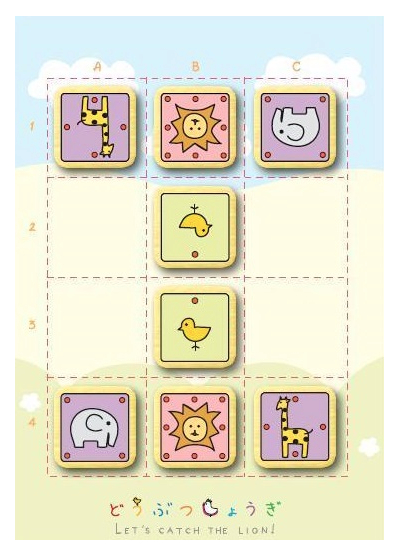
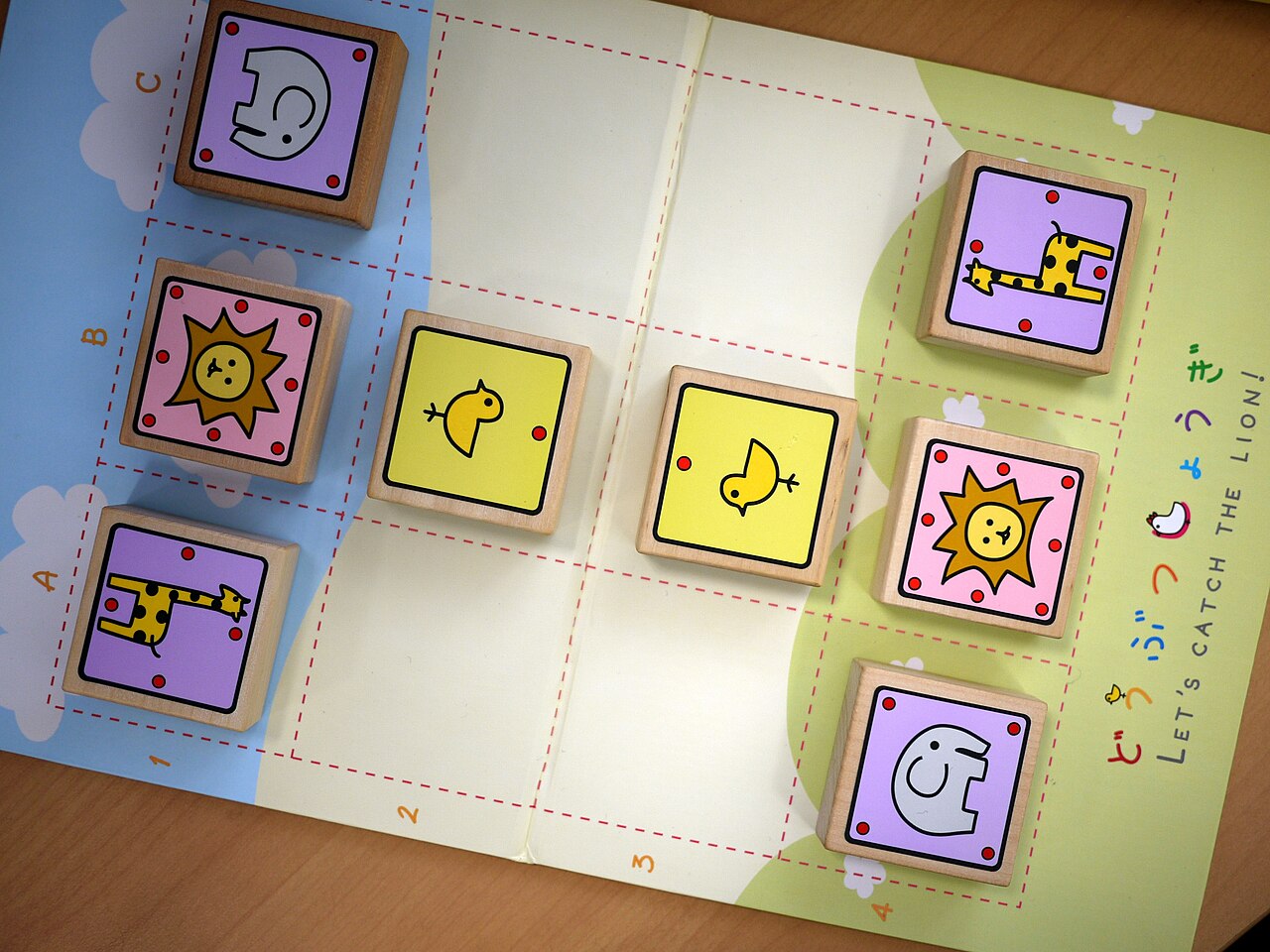
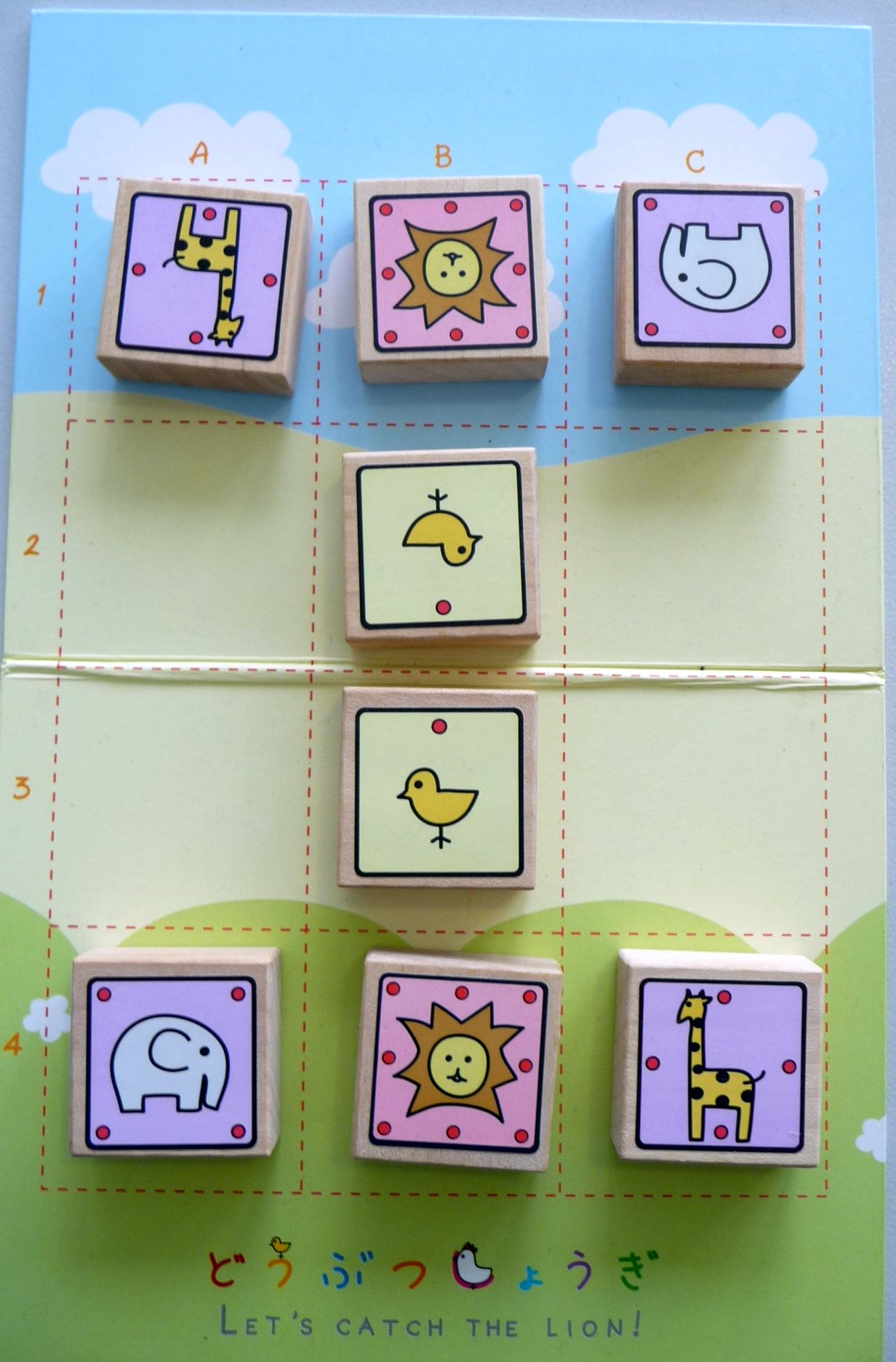
Dōbutsu shōgi was invented by women's professional shogi player Madoka Kitao, partially to attract young girls to the game. The pieces were designed by fellow women's professional shogi player Maiko Fujita. The pieces are square, like children's blocks, have cartoon figures of the relevant animal rather than kanji to identify them, and often have dots on the sides and corners of the directions the pieces can move.
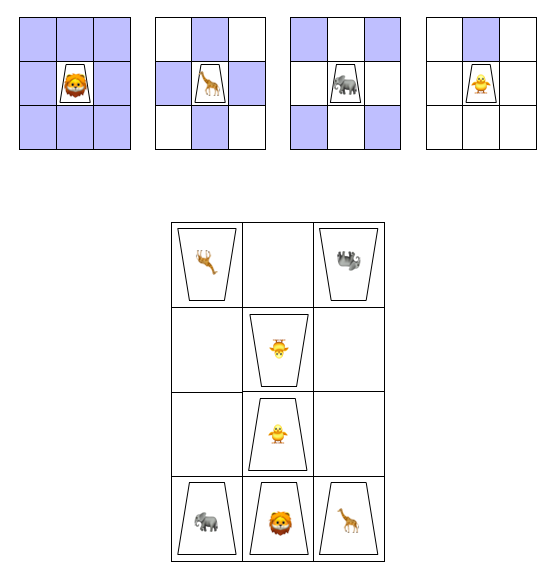
Each player starts with four pieces: a Lion (king) in the center of the home row ("forest"), a Giraffe (rook) to the right of the king, an Elephant (bishop) to the left of the king, and a Chick (pawn) in front of the king. Each moves as in standard shogi but is limited to one square per turn. If the Chick advances to the final rank, it promotes to a Hen (tokin), which can move one square any way except diagonally backwards. A chick dropped on the final rank does not promote and may make no further moves until recaptured.
If the players play the same position three turns in a row, the game is a draw. Perpetual check is also a draw. There are two ways to win: capturing the opponent's Lion, or advancing one's own Lion into the promotion zone as long as doing so does not place one's Lion in check.
Reader's Guide
Dōbutsu shōgi was strongly solved in 2009 by Tetsuro Tanaka, who used retrograde analysis to determine the optimal outcome from every position reachable from the starting setup. There are 246,803,167 such reachable positions. The second player to move (White) has a winning strategy from the starting position, although the theoretical win may take up to 78 plies (39 moves on each side). Thus, the game begins in a zugzwang position, in which the first player to move is at a disadvantage. By symmetry, the game also begins in a Trébuchet position, a full-point zugzwang position, in which the side to begin movement eventually loses.
All opening moves for the first player except capturing the second player's chick delay loss by 78 plies with perfect play; capturing the chick delays loss by only 76 plies. In general, the giraffe is stronger than the elephant. Having pieces in hand ready to drop is highly advantageous. The game does not lend itself well to handicap play, because a handicap of an elephant or a giraffe results in the handicap taker having a relatively easy forced mate.
A 5×6 version with 16 pieces is known as goro goro dōbutsu shōgi, which uses 3 chicks, 2 cats, 2 dogs, and 1 lion per side. A 9×9 version known as "Dobutsu shogi in the Greenwood" is identical to shogi and features new pieces such as boars and rabbits.
Did You Know?
- Dōbutsu shōgi was invented by women's professional shogi player Madoka Kitao, partially to attract young girls to the game.
- The pieces were designed by fellow women's professional shogi player Maiko Fujita.
- The game was strongly solved in 2009 by Tetsuro Tanaka, who found 246,803,167 reachable positions.
- The second player (White) has a winning strategy from the starting position, with a theoretical win taking up to 78 plies.
Origins & Design Philosophy
Dōbutsu shōgi, literally "animal shogi," was conceived as a compact variant of the classic Japanese board game specifically tailored for young children. Its creator, Madoka Kitao, a women's professional shogi player, had a clear motivation: drawing young girls into a game that could otherwise feel intimidating to newcomers. To make the experience approachable and visually engaging, she enlisted fellow women's professional Maiko Fujita to design the playing pieces. Rather than the traditional kanji characters found on standard shogi tokens, Fujita crafted square, block-like pieces featuring cheerful cartoon animals. The Lion, Giraffe, Elephant, and Chick each carry small dots along their edges and corners, intuitively showing a child which directions that piece can travel. This child-centered design philosophy extends to the game's international branding, where it has been marketed under the playful title "Let's Catch the Lion!" The result is a variant that preserves the strategic depth of shogi while wrapping it in a package that feels more like a toy than a formal competition.
Rules & Gameplay Mechanics
Each player commands just four pieces arranged on a compact 3×4 board: a Lion serving as the king sits at the center of the home row, flanked by a Giraffe (functioning as the rook) on the right and an Elephant (the bishop) on the left, with a Chick (the pawn) positioned directly ahead. All pieces follow their standard shogi movement patterns but are restricted to a single square per turn. When a Chick advances two squares to reach the far rank—poetically called the "sky"—it promotes into a Hen, gaining the ability to move one square in any direction except diagonally backward, mirroring the gold general. Captured Hens return to the hand as Chicks, and unlike standard shogi, the usual drop restrictions (no two pawns on a file, no immediate checkmate, no dropping on the final rank) are lifted. A Chick dropped on the final rank, however, cannot promote or move until recaptured. Victory comes either by capturing the opponent's Lion or by marching one's own Lion into the farthest rank, provided it is not left in check. Three consecutive repetitions of the same position, or perpetual check, both result in a draw.
Theoretical Solution & Game Theory
In 2009, mathematician Tetsuro Tanaka applied retrograde analysis to exhaustively map every position reachable from the starting setup, identifying 246,803,167 distinct reachable states (a larger figure of 1,567,925,964 sometimes cited merely counts all possible piece arrangements, including those that never occur in actual play). The result was striking: the second player, called White in shogi terminology, holds a forced win from the very first move, though perfect play may require as many as 78 plies—thirty-nine moves per side. This means the game opens in a zugzwang, where the player who must move first is at a disadvantage, and by symmetry it is also a Trébuchet position, a full-point zugzwang in which the side to begin movement is destined to lose. Interestingly, every legal first move except capturing the opponent's Chick delays the inevitable defeat by the full 78 plies; grabbing the Chick shortens the resistance to just 76. Beyond the opening, Tanaka's work revealed that the Giraffe is the stronger of the two ranged pieces, and that holding pieces in hand ready to drop confers a significant advantage. The game resists handicap play, as removing a Giraffe or Elephant gives the weaker side a relatively straightforward forced mate.
Variations & Expansion
Dōbutsu shōgi has inspired larger-scale adaptations that scale up the animal-themed concept. The 5×6 variant, goro goro dōbutsu shōgi (also known as goro goro shogi), expands the army to sixteen pieces per side: three Chicks, two Cats (silvers), two Dogs (golds), and one Lion. Here, Chicks promote to Hens and Cats to empowered Cats, both of which then move identically to the Dog. Promotion zones span the first and last two ranks, and the standard shogi restrictions on drops—such as the two-pawn rule and the prohibition on dropping a pawn with immediate checkmate—return to full effect. Perpetual check, defined as a four-move repetition, still results in a draw. At the other extreme, a 9×9 version titled "Dobutsu shogi in the Greenwood" (ōkina mori no dōbutsu shōgi) is functionally identical to standard shogi but retains the animal nomenclature. On this larger board, the Elephant and Giraffe regain unlimited range, and two new pieces appear: Boars (lances) and Rabbits (knights), each promoting to empowered versions that move like the Dog, while the Elephant and Giraffe can promote to their dragon-horse and dragon-king equivalents.
Gallery
Frequently Asked Questions
What is Dōbutsu shōgi?
Dōbutsu shōgi, sold internationally under the name "Let's Catch the Lion!", is a simplified shogi variant made specifically for young children. It keeps core shogi mechanics such as piece drops but plays on a tiny 3×4 board with animal-themed pieces.
Who created Dōbutsu shōgi?
The game was invented by Madoka Kitao, a women's professional shogi player, while her fellow women's professional Maiko Fujita designed the animal pieces used in play.
How does Dōbutsu shōgi differ from standard shogi?
Every piece is limited to a single square of movement per turn, the board shrinks to just 3×4, and a second victory condition is added: advancing your own lion to the enemy's back row also ends the game.
How do you win at Dōbutsu shōgi?
A player can win in two ways: by capturing the opponent's lion (the king) or by moving their own lion into the enemy camp, which is an extra win path not found in regular shogi.
When was Dōbutsu shōgi mathematically solved?
Mathematician Tetsuro Tanaka proved in 2009 that the opening player has a forced win, meaning perfect play from the first move guarantees victory for the side that moves first.
More in Children's board games 1-24
Spotted an error? Know more?
This is a living reference — every entry is fact-audited, and reader corrections feed straight into our audit queue. Suggest an edit · See this site's audit record