
Battling Tops
A spinning top battle game first released in 1968.

Wikipedia / Wikimedia Commons
Battling Tops is a game for children created by Eddy Goldfarb and first put out by Ideal in 1968. Players send spinning tops into a round arena, competing to be the one with the last top still spinning. The game shares features with gasing pangkah, a traditional Malay sport.
Two to four players take part. They wind a string, attached to a pull tab, around their top, place it at one of four launch points, and yank the tab to set it spinning. The arena is concave, which pushes the tops together for collisions. The outcome is mostly random, though a small amount of skill is involved. Pegs around the arena’s rim track wins; the first to win ten battles wins the game.
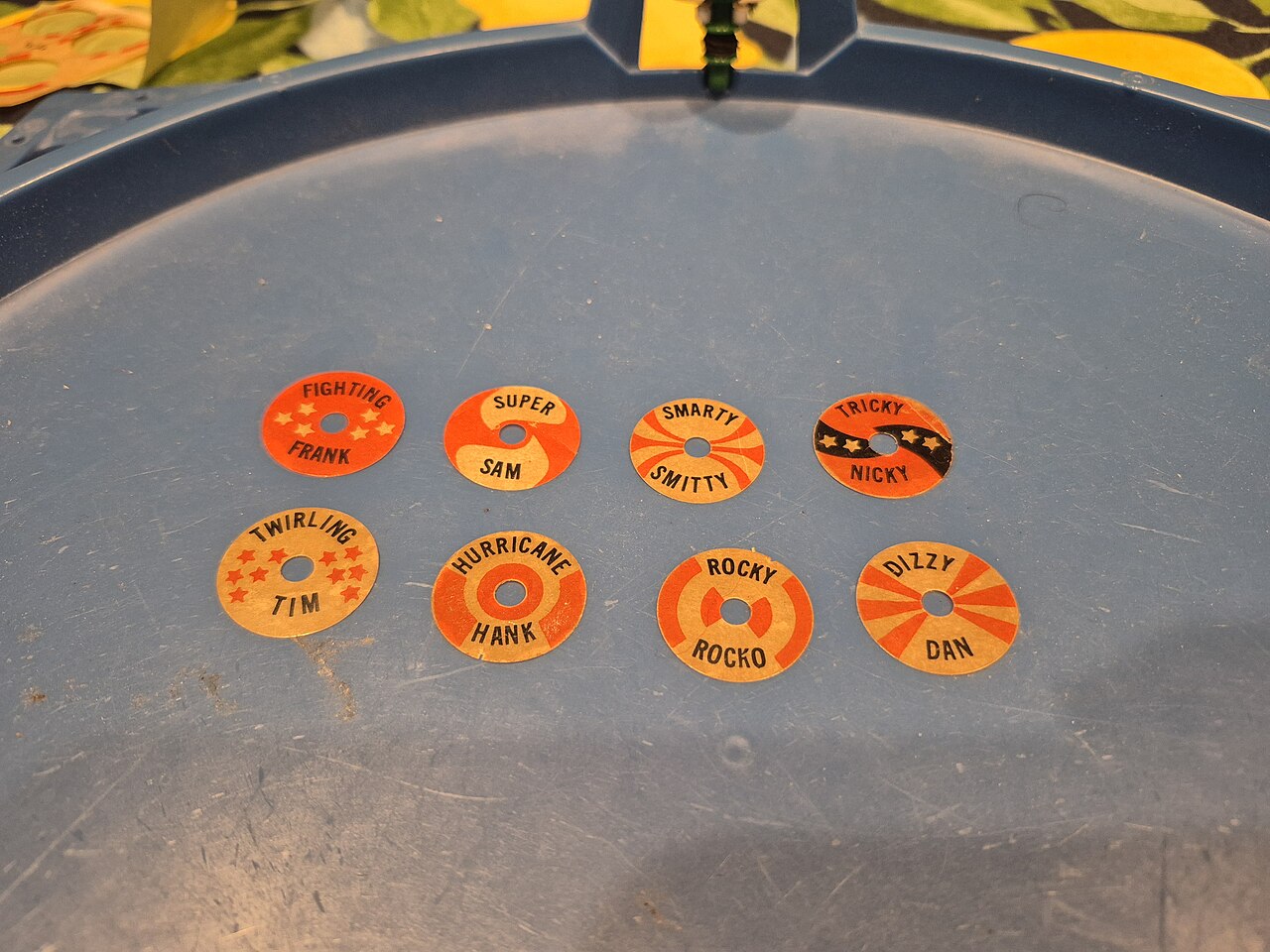
Players could choose from six colored tops: Hurricane Hank, Twirling Tim, Dizzy Dan, Smarty Smitty, Super Sam, and Tricky Nicky, though only four could battle at once. Each top had an octagonal disc fitted over a ridged shaft with a notch for the string. A sheet of colored stickers came with the game, meant to match the disc and shaft colors, but players could mix and match shafts, discs, and stickers (though stickers only stuck once). In a later version, Smarty Smitty was replaced by Cyclone Steve. The 1968 version included an eight-top set with Fighting Frank and Rocky Rocko, but only four colors, so there were two of each. The six-player sets came in red, yellow, green, light blue, white, and orange.
In 1977, the game was renamed Battling Spaceships to ride the Star Wars craze. After Ideal was sold in 1982, Marx took over production. By the late 1980s, it was no longer made. Mattel brought Battling Tops back in 2003.
- inventor
- Eddy Goldfarb
- first_manufacturer
- Ideal
- year_introduced
- 1968
- number_of_players
- 2 to 4
- win_condition
- First to win ten battles
- original_top_colors
- red, yellow, green, light blue, white, orange
- original_character_names
- Hurricane Hank, Twirling Tim, Dizzy Dan, Smarty Smitty, Super Sam, Tricky Nicky
Lore & Background
Battling Tops was invented by Eddy Goldfarb and first manufactured by Ideal in 1968. The game involves two to four players launching spinning tops into a circular concave arena. Players wind a string attached to a pull tab around their tops, place them in launch positions, and pull the tab vigorously to release the top. The concave surface forces the tops together to battle, with the outcome somewhat indeterminate but involving a slight element of skill. Pegs in holes on the rim of the arena mark victories, and the first to win ten battles wins the game.
The game originally featured six different colored tops with character names: Hurricane Hank, Twirling Tim, Dizzy Dan, Smarty Smitty, Super Sam, and Tricky Nicky, though only four could battle at once. The tops were composed of octagonal discs slipped over a ridged shaft with a notch to engage the string. A sheet of colored stickers was included to match disc and shaft colors, but mixing and matching was possible, with the proviso that stickers only stuck once. In the 1968 version, an eight-top version included Fighting Frank and Rocky Rocko but only four colors, giving four sets of two. The six-player sets had red, yellow, green, light blue, white, and orange tops.
In 1977, the game was renamed Battling Spaceships in response to Star Wars fever. After Ideal was sold in 1982, Marx took over the game. By the late 1980s, the game was out of production. In 2003, Mattel rereleased Battling Tops. In the new version, Smarty Smitty was replaced by Cyclone Steve.
Reader's Guide
Battling Tops holds significance as a classic children's game that introduced a simple yet engaging physical competition using spinning tops. Its design, with a concave arena forcing tops together, created a dynamic that blended chance with a slight element of skill, making it accessible to a wide age range. The game's legacy is evident in its multiple iterations and re-releases, including a 1977 rebranding as Battling Spaceships to capitalize on Star Wars popularity, and a 2003 rerelease by Mattel. The game also shares conceptual similarities with the traditional Malay sport gasing pangkah, linking it to a broader cultural tradition of top-spinning contests. While out of production by the late 1980s, its influence can be seen in later spinning-top battle games such as Beyblade and Battle Strikers. The inclusion of named characters and colored tops added a collectible and personalization aspect, with the ability to mix and match parts. The game's enduring appeal is reflected in its continued mention in reference works and its status as a nostalgic item for those who played it in the late 1960s through the 1980s.
Did You Know?
- The game was renamed Battling Spaceships in 1977 in response to Star Wars fever.
- In the new version of the game, Smarty Smitty was replaced by Cyclone Steve.
- The 1968 version included an eight-top version with Fighting Frank and Rocky Rocko but only four colors.
- The game has similarities to gasing pangkah, a traditional Malay sport.
Origins & How the Game Works
Battling Tops entered the toy world in 1968, the brainchild of inventor Eddy Goldfarb and brought to shelves by the Ideal company. The core concept is deceptively simple: two to four players each wind a string—attached to a pull tab—around their spinning top, seat it in one of four launch positions on a circular concave arena, then yank the tab hard to send the top spinning into the center. The curved, bowl-shaped surface is the game's secret weapon, naturally funneling the tops toward one another so they collide and battle. Victory goes to whoever keeps their top spinning the longest, with a slight edge given to players who can time and angle their launch with a touch of skill, even though the outcome remains largely unpredictable. Wins are tracked by sliding pegs into holes around the arena's rim, and the first player to rack up ten victories claims the match. Interestingly, the game shares a conceptual kinship with gasing pangkah, a traditional Malay spinning-top sport, suggesting the appeal of top combat stretches far beyond Western toy aisles.
Characters, Design & Player Customization
The original 1968 set introduced six personality-driven competitors, each given a playful name: Hurricane Hank, Twirling Tim, Dizzy Dan, Smarty Smitty, Super Sam, and Tricky Nicky. Though six tops shipped in the box, the arena's four launch slots meant only four could clash in any given round. Each top was built from an octagonal disc that slid over a ridged shaft, the shaft featuring a small notch designed to catch the winding string. A sheet of colored stickers accompanied the set, intended to dress the disc and shaft in matching hues—red, yellow, green, light blue, white, and orange for the standard six-player configuration. Yet the design allowed for creative mixing: players could swap shafts, discs, and stickers freely, with the one caveat that the adhesive stickers could only be applied once. In a later revision, Smarty Smitty was swapped out for Cyclone Steve. The original 1968 run also included an eight-top variant adding Fighting Frank and Rocky Rocko, though that version used only four colors, creating four pairs.
A Bumpy Corporate Journey
Battling Tops has had a notably turbulent corporate life. Born under the Ideal brand in 1968, the game rode a wave of cultural enthusiasm in 1977 when it was rebranded as Battling Spaceships, a direct nod to the Star Wars craze sweeping the country. That rebranding, however, proved to be a brief interlude rather than a lasting transformation. In 1982, Ideal was sold, and the game passed into the hands of Marx, which continued producing it for a few more years. By the late 1980s, the title had quietly disappeared from shelves, and for nearly two decades it existed only in the memories of children who had once yanked a pull tab in a plastic bowl. Then in 2003, Mattel stepped in with a fresh rerelease, reintroducing the concept to a new generation of players. The journey from Ideal to Marx to Mattel mirrors the broader reshuffling of the American toy industry during that era, and the game's survival through three different corporate owners speaks to the enduring appeal of its simple, competitive format.
Cultural Roots & Place in the Spinning-Top Lineage
Long before plastic tops and pull tabs, the fundamental idea of spinning-top combat had deep roots in Southeast Asian culture. Battling Tops bears a clear conceptual resemblance to gasing pangkah, a traditional Malay sport in which players battle spinning tops for supremacy. This parallel suggests that the game's inventor, Eddy Goldfarb, was tapping into a universal human fascination with kinetic competition that transcends any single culture or era. In the modern toy landscape, Battling Tops occupies a similar niche to later phenomena like Beyblade and Battle Strikers, all of which center on launching spinning objects into a shared arena and letting physics decide the victor. What set Battling Tops apart in its 1968 debut was its deliberate embrace of unpredictability: the concave arena and the tops' collisions made each round feel like a small, chaotic event, where a flick of the wrist could tip the balance. That blend of chance and marginal skill gave it a democratic, accessible quality that resonated with children and kept the game in rotation across three different manufacturers over more than three decades.
Gallery

Frequently Asked Questions
Who created Battling Tops and when was it first released?
Eddy Goldfarb designed the game, and Ideal brought it to shelves in 1968. It was made for children and supports two to four players at a time.
How does a single round of Battling Tops actually work?
Each player wraps a string around their top, sets it at one of four launch spots, and yanks the pull tab to send it spinning into the concave arena. The curved walls force the tops to collide, and whoever's top is still turning at the end takes the battle.
What is the win condition in Battling Tops?
The overall match goes to the first player to claim ten individual battles. Because the results lean heavily toward chance, a player's skill influences the outcome only marginally.
What top colors came in the original Battling Tops set?
The first edition shipped with six top colors: red, yellow, green, light blue, white, and orange.
Does Battling Tops draw on any real-world tradition?
Yes—the game borrows its core concept from gasing pangkah, a long-standing Malay top-spinning sport. The idea of launching spinning tops into a shared arena to knock each other out mirrors that tradition.
More in Children's board games 1-24
Spotted an error? Know more?
This is a living reference — every entry is fact-audited, and reader corrections feed straight into our audit queue. Suggest an edit · See this site's audit record