
Aeroplane chess
Chinese cross-and-circle board game using airplane pieces.

Wikipedia / Wikimedia Commons
Aeroplane chess, known in Chinese as *fēixíng qí* (literally "aviation game" or "flying chess"), is a cross-and-circle board game from China. It resembles the Western game Ludo and the Indian game Pachisi, but uses miniature airplanes as playing pieces instead of the abstract pawns or beehive-shaped tokens found in those earlier games. The game was developed during the 1900s, and its inventor is unknown, though it may have been directly adapted from Ludo. It has since entered the public domain and is considered one of China's classic modern board games, alongside Jungle and Luzhanqi. Aeroplane chess has also spread internationally, particularly in Africa.
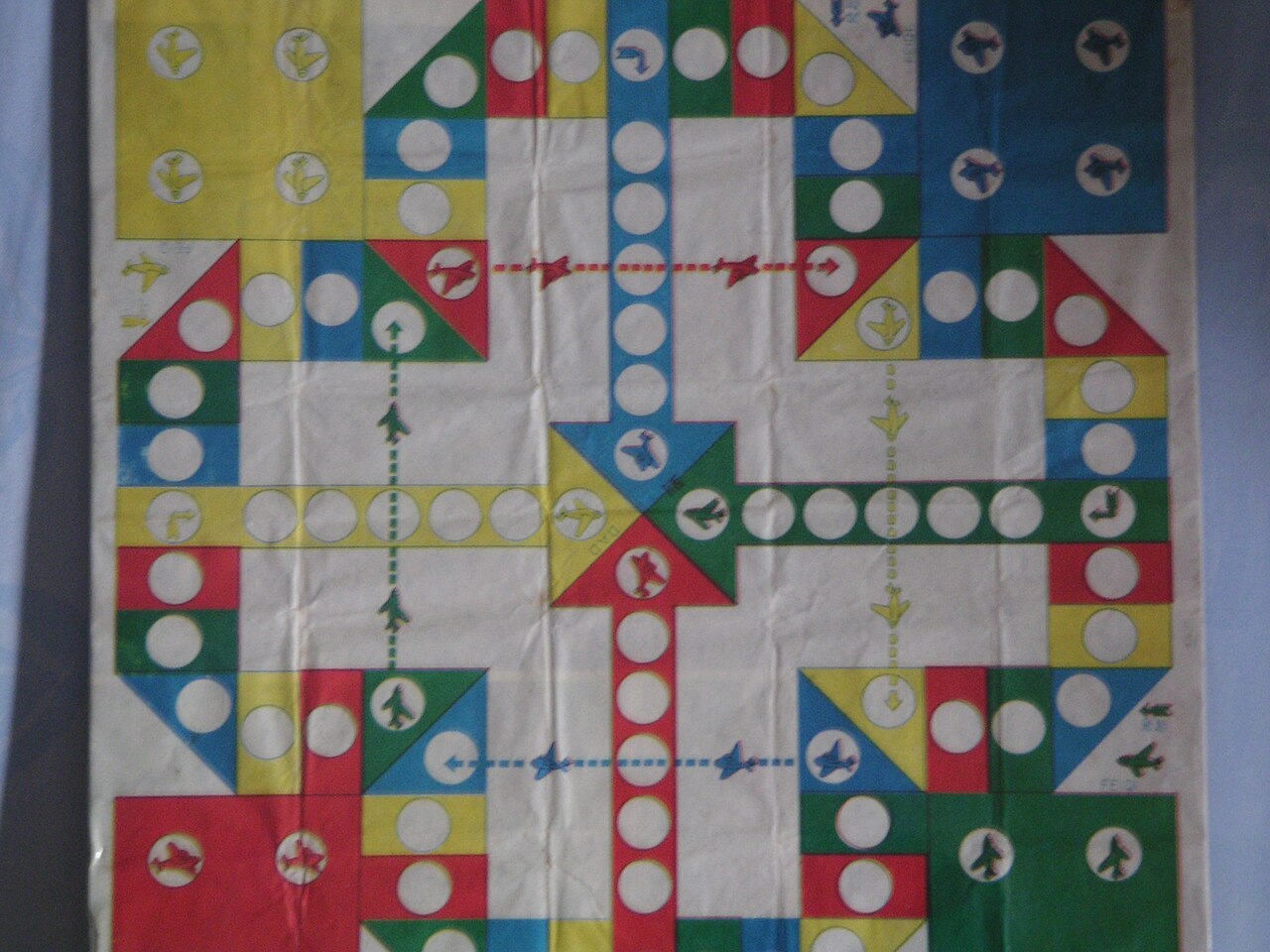
The game is played by two to four people, each controlling four airplane pieces of a single color—typically red, yellow, blue, or green. The board has four starting hangars in the corners, each with an adjacent launch area, and a 52-space multicolored track that cycles through the four colors. From the track, four arrow-shaped home zones lead inward to the center of the board, which serves as the goal. There are also four shortcut spaces, one per color, often marked with a dashed line and arrow. Play uses a standard six-sided die.
The objective is to move all of one’s own planes from their hangar, around the track, and into the center base of the opponent’s color. A player can only bring a piece onto the board by rolling a six, which also grants an extra turn. On subsequent turns, the player moves a piece clockwise along the track by the number shown on the die. Rolling a second consecutive six gives a third roll; a third consecutive six forces any pieces moved by the first two sixes back to their hangar, and the turn ends.
If a piece lands on an opponent’s piece, that opponent’s piece is sent back to its hangar. Landing on a space matching the piece’s own color triggers an immediate four-space jump to the next space of that color, and any opposing planes on those jumped squares are also sent back. Landing on a shortcut space of one’s own color allows the piece to take the shortcut, sending any opposing planes under the dashed line back to their hangars. A jump and a shortcut can happen in succession if the jump leads directly to a shortcut.
To finish, a plane must reach the center base on an exact die roll. Once there, it is placed face down in its own hangar, indicating it is done. The first player to
- Type
- Board game
- Origin
- China
- Derived from
- Ludo and Pachisi
- Number of players
- 2 to 4
- Equipment
- Gameboard, 4 sets of 4 colored airplane pieces, one 6-sided die
- Objective
- Get all four plane pieces from hangars to the centre base
- Status
- Public domain
Lore & Background
Aeroplane chess was developed in the 20th century, though its inventor is not known. It may have been developed directly from Ludo. The game has entered the public domain and is now considered one of China's classic modern board games, alongside Jungle and Luzhanqi. The gameboard features four starting hangars in each corner, a multicolored track of 52 spaces evenly divided among red, yellow, blue, and green, four arrow-shaped home zones, four shortcut spaces, and four sets of four colored airplane pieces.
Reader's Guide
Aeroplane chess is played by two to four players, each trying to move all four of their airplane pieces from their hangar into the centre base. A player must roll a six to move a piece from the hangar to the launch area. Rolling a six grants an extra turn, but three consecutive sixes cause any pieces moved by the first two sixes to return to their hangar. Landing on an opponent's piece sends that piece back to its hangar. Landing on a space of one's own color triggers a four-space jump, and landing on a shortcut space of one's own color allows a shortcut, both of which can send opposing pieces back. The game ends when a player gets all four planes into the centre base on exact rolls; the rest continue until only one loser remains. Optional rules include evens for hangar exit, stacking of same-color pieces, and various battle mechanics. The game's significance lies in its status as a classic Chinese board game that has spread globally, particularly in Africa, and its adaptation of traditional cross-and-circle mechanics with an aviation theme.
Did You Know?
- Aeroplane chess features airplanes as pieces instead of the more abstract pawns found in Ludo and Pachisi.
- The game has spread around the world, especially in Africa.
- A roll of six gives the player another roll, but three consecutive sixes cause any pieces moved by the first two sixes to return to their hangar.
- When a plane lands on a space of its own colour, it immediately jumps four spaces ahead to the next space of its own colour.
Origins & Cultural Context
Aeroplane chess, known in Chinese as fēixíng qí and literally translating to "aviation game" or "flying chess," is a cross-and-circle board game that emerged in China during the twentieth century. Its exact inventor remains unknown, though the design may have evolved directly from the Western game of Ludo, which itself shares deep roots with the Indian tradition of Pachisi. What distinguishes aeroplane chess from these predecessors is its visual identity: rather than the abstract pawns or beehive-shaped tokens found in Ludo and Pachisi, players pilot small airplane pieces across the board. The game has since entered the public domain and now stands alongside Jungle and Luzhanqi as one of China's most recognized classic modern board games. Its reach extends well beyond Chinese-speaking communities; it has spread around the world and found particular popularity in Africa. Because no single company owns the design, aeroplane chess is manufactured in a wide variety of packages by numerous producers, each offering slightly different aesthetics while preserving the core structure.
The Board & Its Architecture
The physical layout of an aeroplane chess set is deceptively simple yet richly structured. At each of the four corners sits a starting hangar, colour-coded to match one of the four players—red, yellow, blue, and green—with an adjacent launch area where planes first enter the track. The central feature is a multicoloured circular track of exactly 52 spaces, divided evenly among the four colours so that each player's hue appears thirteen times around the loop. Radiating inward from the track are four arrow-shaped home zones, each funneling a player's planes toward the end spaces at the very centre of the board. Scattered along the track are four shortcut spaces, one per colour, typically marked with a dashed line and a small arrow to signal the alternate route. Players manipulate four airplane pieces per colour, and a standard six-sided die drives every decision. The combination of corners, loop, shortcuts, and central finish line creates a layered geometry that rewards both careful planning and fortunate rolls.
Core Gameplay & the Dance of Sixes
Two to four players compete to ferry all four of their airplane pieces from the corner hangars to the centre of the board. Each turn begins with a die roll. A six is the only roll that lets a plane leave its hangar for the launch area; otherwise, a player advances a piece already on the track clockwise by the number shown. The six carries a special rhythm: rolling it grants an extra turn, and a second consecutive six grants yet another. A third consecutive six, however, is a curse—any planes moved during the first two sixes must return to their hangars, and play passes on. Landing on an opponent's plane sends it back to its hangar. Landing on a space of one's own colour triggers an automatic four-space jump to the next matching-colour square, sweeping any opponents in that path back as well. Shortcut spaces, marked by dashed lines, offer an alternate route and can be chained with a jump. To finish, a plane must enter the centre base on an exact roll; the first player to land all four planes there wins, while remaining players continue until a single loser is determined.
Folk Rules & Living Tradition
Like many beloved board games, aeroplane chess thrives on the rules that players invent for themselves, lending the game a distinctly colloquial and folkloric character. House variants are as varied as the families and friend groups who play them. The "Evens" rule, for instance, allows a plane to launch from the hangar on any even-numbered roll rather than requiring a six. "Stacked Movement" lets a player pile same-colour planes on top of one another and move them as a single unit until an opponent lands on the stack. "Dice Battle" replaces automatic capture with a contested roll: when two planes collide, both players roll the die and the lower roll is sent back. "Open Shortcut" permits a player to use any shortcut space regardless of colour, while "Home Zone Backtrack" forces a player who cannot make an exact roll into the centre to move their piece backwards by the number rolled. "Double Six" shortens the curse so that a second consecutive six—rather than a third—triggers the return of moved pieces. These optional layers mean that no two tables play quite the same game, and the tradition of improvisation keeps aeroplane chess feeling alive across generations and continents.
Gallery
Frequently Asked Questions
What is Aeroplane chess?
Aeroplane chess is a Chinese cross-and-circle board game that plays much like Ludo or Pachisi but swaps the usual pawns for small airplane tokens. It has been a go-to family pastime in China since the early 1900s and is often grouped with Jungle and Luzhanqi as a classic modern board game.
How many people can play Aeroplane chess?
The game is designed for two to four players, each commanding a team of four colored airplane pieces. Turns are taken by rolling a single six-sided die and moving the corresponding plane forward.
What equipment do you need to play Aeroplane chess?
All you need is a cross-shaped gameboard, four sets of four colored airplane pieces, and one standard six-sided die. There are no cards, scoring sheets, or other extra components required.
Where did Aeroplane chess come from and who invented it?
The game originated in China sometime during the 1900s, and no individual inventor has ever been credited. It is widely understood to be a direct adaptation of the Western Ludo (itself descended from the Indian Pachisi), and it has since fallen into the public domain.
What is the goal of Aeroplane chess?
Each player must travel all four of their airplanes from the starting hangar around the track and into the central base area. The first player to land every one of their planes in the center wins the round.
More in Children's board games 1-24
Spotted an error? Know more?
This is a living reference — every entry is fact-audited, and reader corrections feed straight into our audit queue. Suggest an edit · See this site's audit record